
DJCSI
Overview
DJCSI is my undergrad university’s CSI (Computer Society of India) committee which organizes an annual hackathon Codeshastra. It is one of the oldest and grandest 24-Hour Hackathon in India.
During my tenure as the Technical Lead of DJCSI, I initiated this project to eliminate the manual management tools (Google Sheets, Excels, Printed sheets for tracking) and replace it with an unified mobile application. The goal of creating this hackathon management system was to efficiently manage all tasks, or as I like to call them Checkpoints, related to the hackathon in real time.
My contribution
User Research Ideation UI/UX Design Interaction Design App Development (Full-stack)
Team
Led a team of 5 3 × developers 2 × designers
Timeline
December 2023 - March 2024

Problem
- 24-Hour hackathon taking 40 hours: Hackathon hours would usually extend due to multiple time-consuming management tasks. This would typically cause it to end around midnight.
- Lower female registrations: The midnight wrap-up time made it unsafe and difficult for everyone, especially women, to travel.
- Risk of misplacement in previous methods: Previously, for tracking different Checkpoints, multiple tables with all participant details were made and printed. Then the status was manually updated on the paper with a tick.
Goal
The goal was to solve all the above problems by decreasing the overall time of the hackathon by automating all the manual and error-prone management tasks.
Design Process
Since we already knew the problem (even experienced it as a participant), there was no definite Define stage. I approached the problem starting with the Research phase.
Research
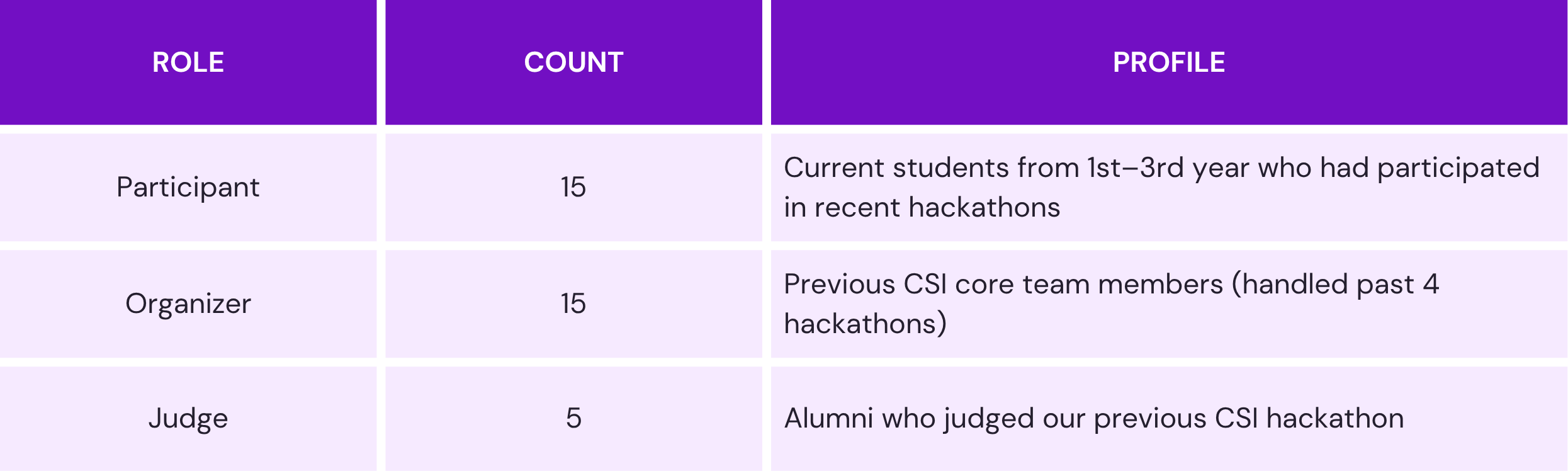
The first step was to define the target audience - Participants, Organizers and Judges.
Then I conducted 35 semi-structured interviews to better understand the challenges faced by different people involved in running and attending CSI hackathons. My goal was to find patterns in the pain points and spot opportunities to automate the process.
Objectives
- Understand where the current hackathon management process was time consuming.
- Validate whether a digital solution could save time and reduce last-minute chaos.
- Identify what each user group actually needed from the system.
Insights
👥 Participants
“We were waiting for over two hours after judging just to hear the results. It was draining.”
- Delays in result announcements after judging rounds caused fatigue and frustration.
- Some teams were missed during mentor check-ins or meals due to errors in manual tracking.
- Final judging + speeches + award ceremonies often meant the event ended around midnight, making travel home feel unsafe.
🧑💼 Admin
“Even with all the committee members, it was hectic to track team progress and calculate scores manually.”
- Check-ins, checkpoint status updates, and judging coordination were chaotic and paper-heavy.
- Printed tracking sheets were sometimes misplaced or outdated in real-time.
- Rank calculation across judges was time-consuming, and when judges requested to change their scores after submission, it introduced bias into the final results.
🧑⚖️ Judges
“I had to flip through sheets and Google Drive folders just to figure out who I was judging. It didn’t feel organized.”
- Paper scorecards felt outdated and error-prone.
- Marking and tallying scores manually led to delays and inconsistencies.
- Judges wanted a digital space with all relevant information in one place: team details, problem statements, and judging criteria.
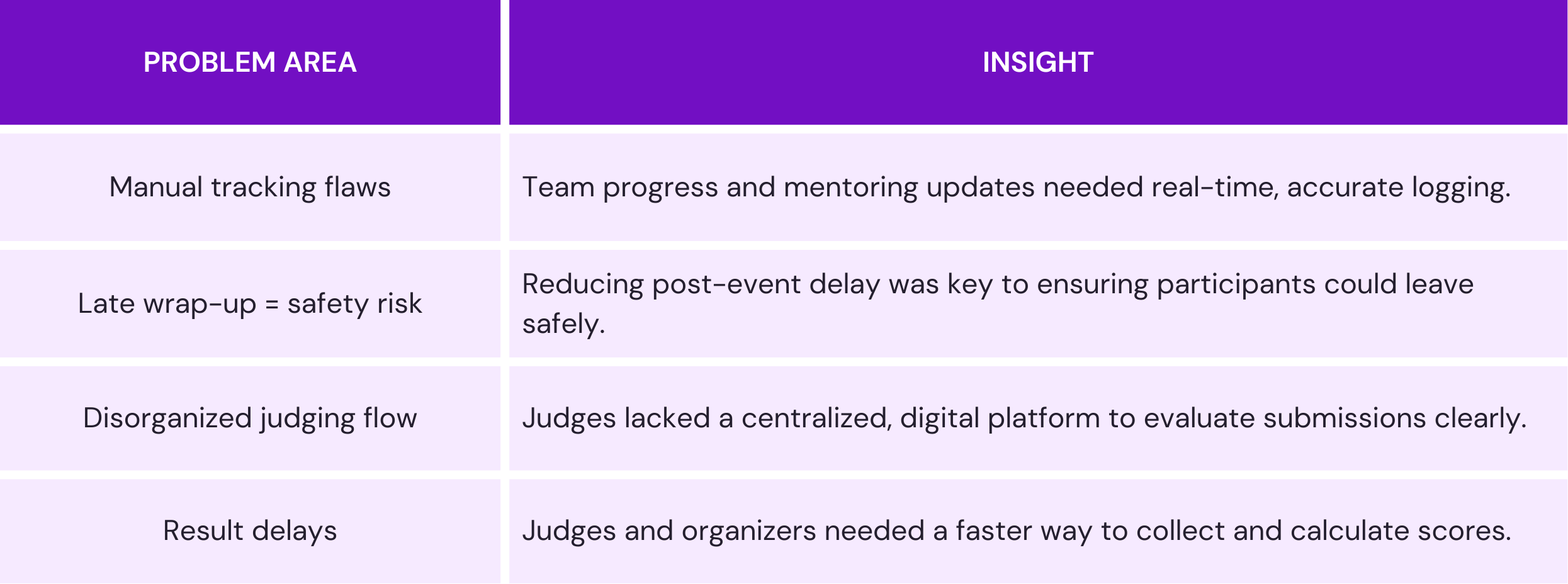
What This Told Me
Research → Ideation
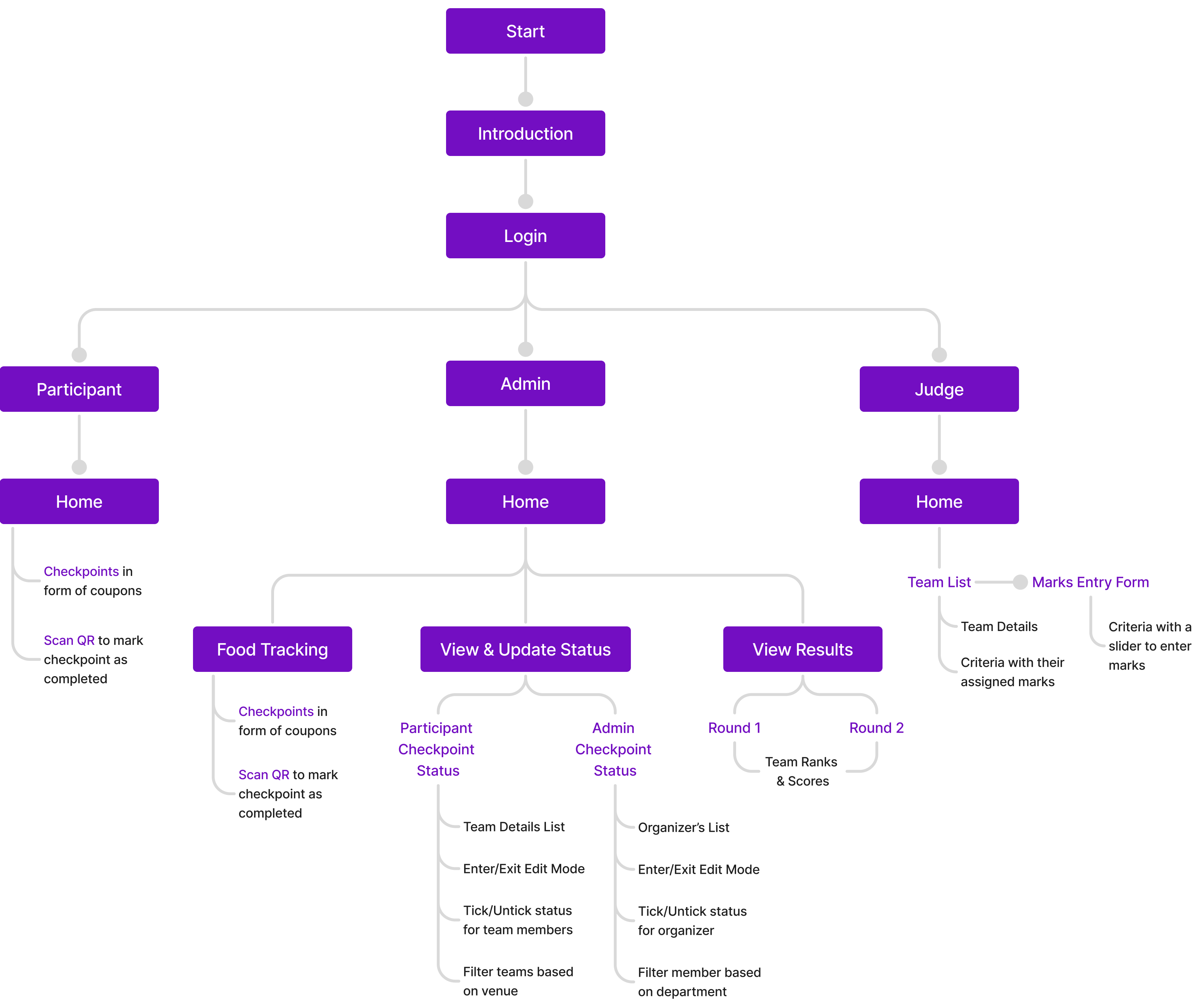
Using the research in the previous phase, we ideated for features and then structured them to include in the final product.
Information Architecture
Research → Ideation → Design
Translating to screens
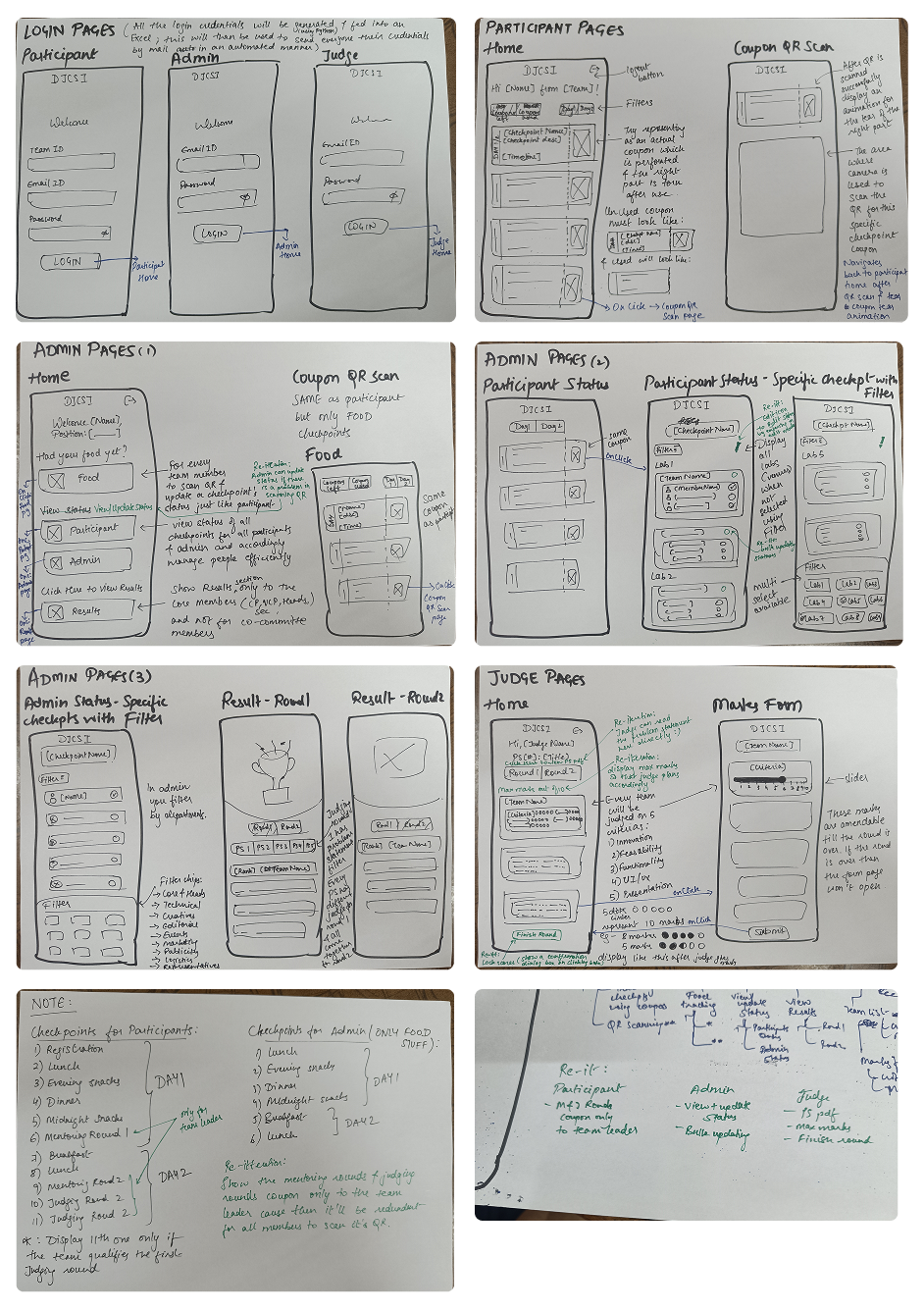
Low-fidelity Wireframes
Some features are added in the iterations post Round 1 of Observation Testing and are shown using a green marker pen. The blue marker pen is used to represent the flow of the prototype.
High-fidelity Prototypes
Since the DJCSI app already existed and we were adding the hackathon management system to it, the UI Style Guide was already established.
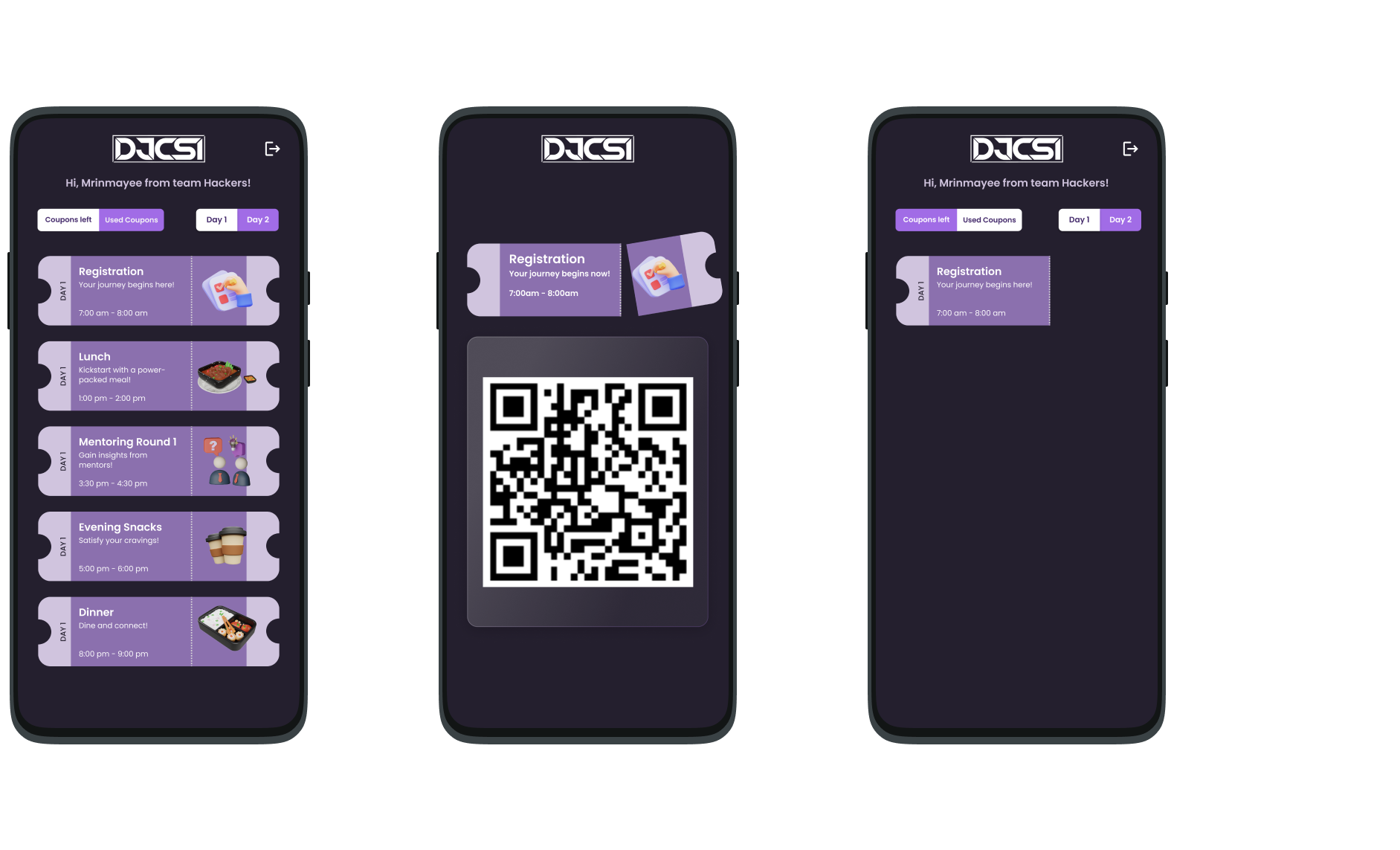
Participant Screens
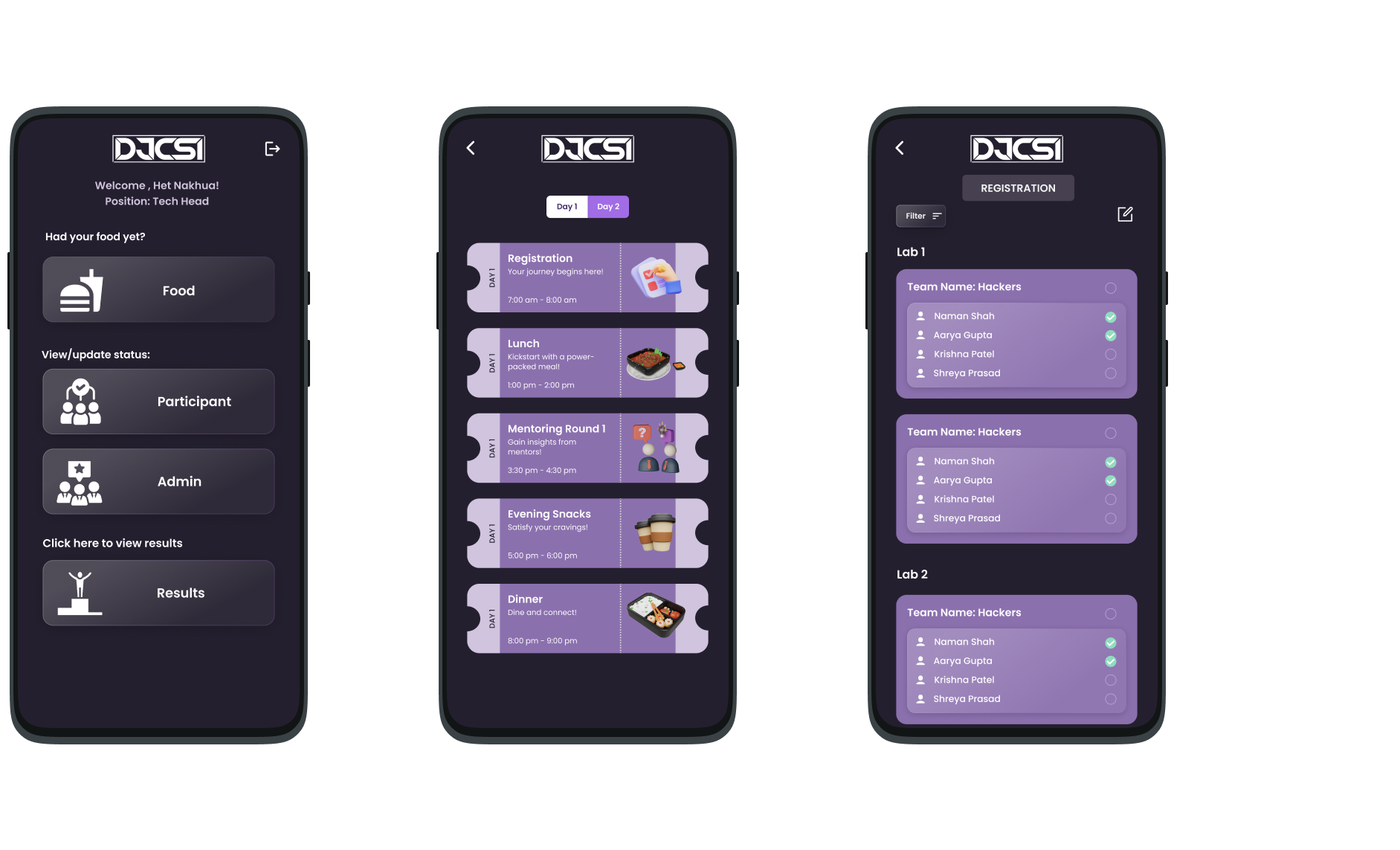
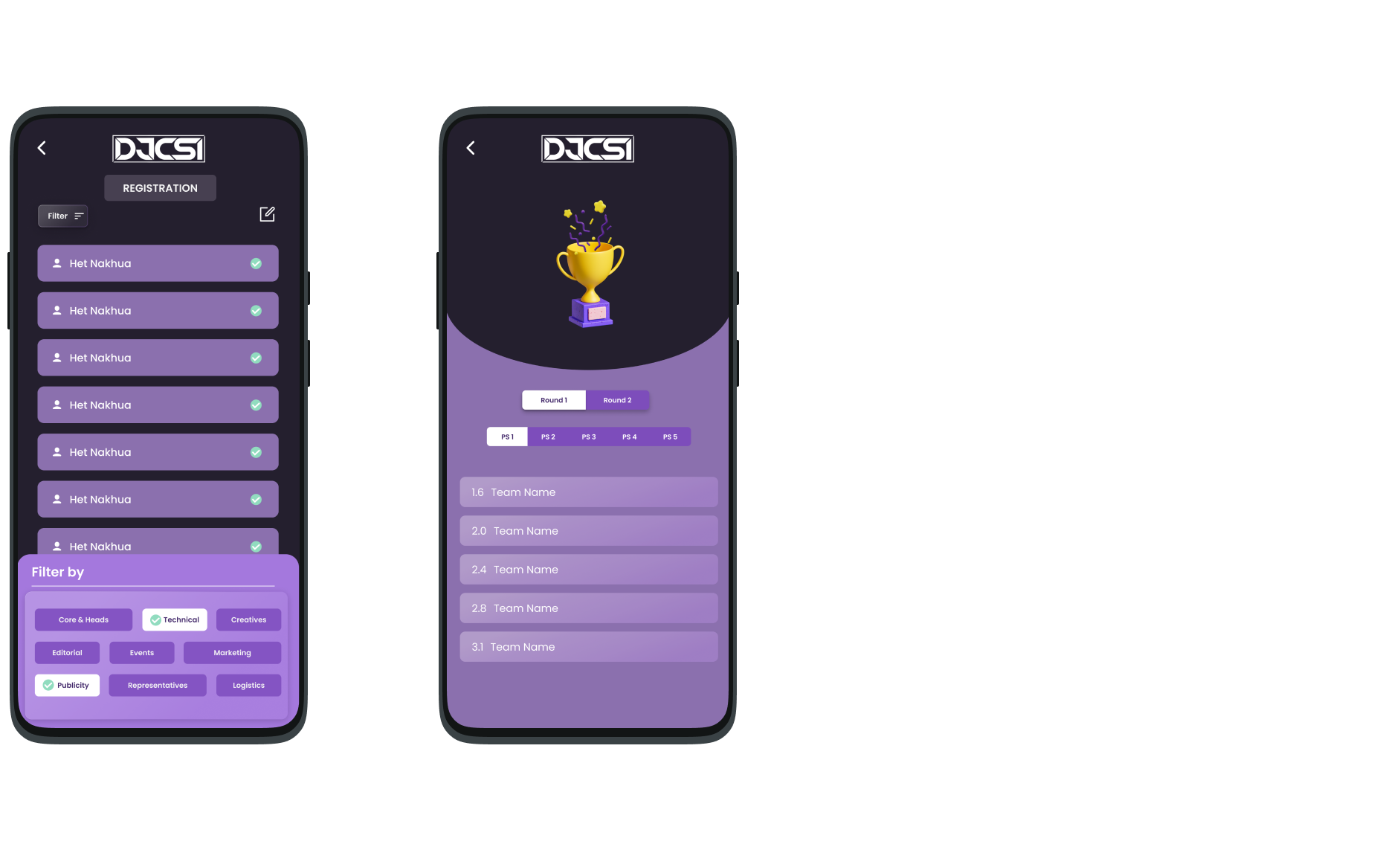
Admin Screens
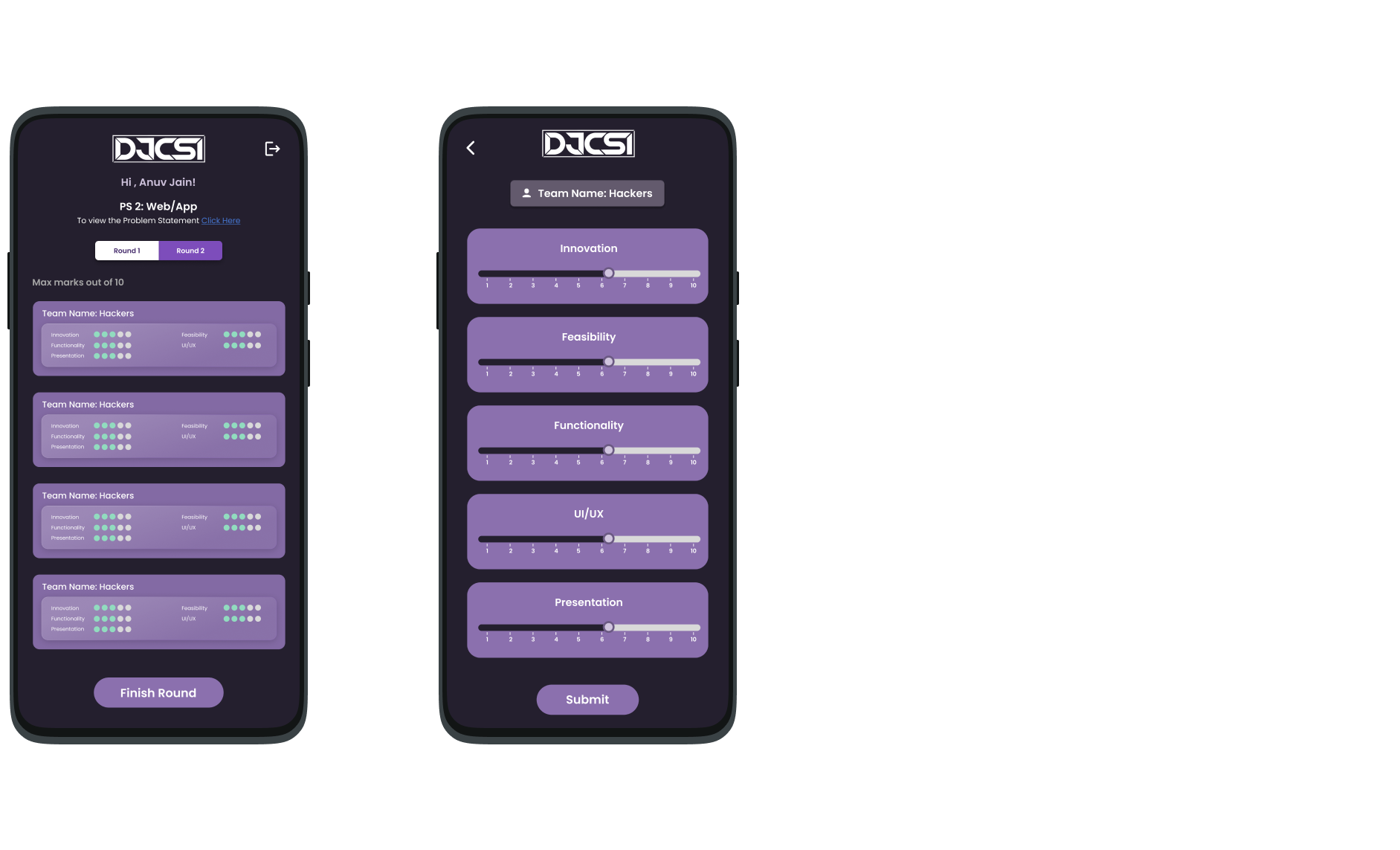
Judge Screens
Research → Ideation → Design → Testing & Iteration
Tested → Reiterated and added some features (marked with green marker pen in wireframes)
I conducted two rounds of Observation Testing with 6 target users to evaluate task flows across all three user roles. In each round, they were given a few tasks to complete and asked to think out loud while they went about doing them.
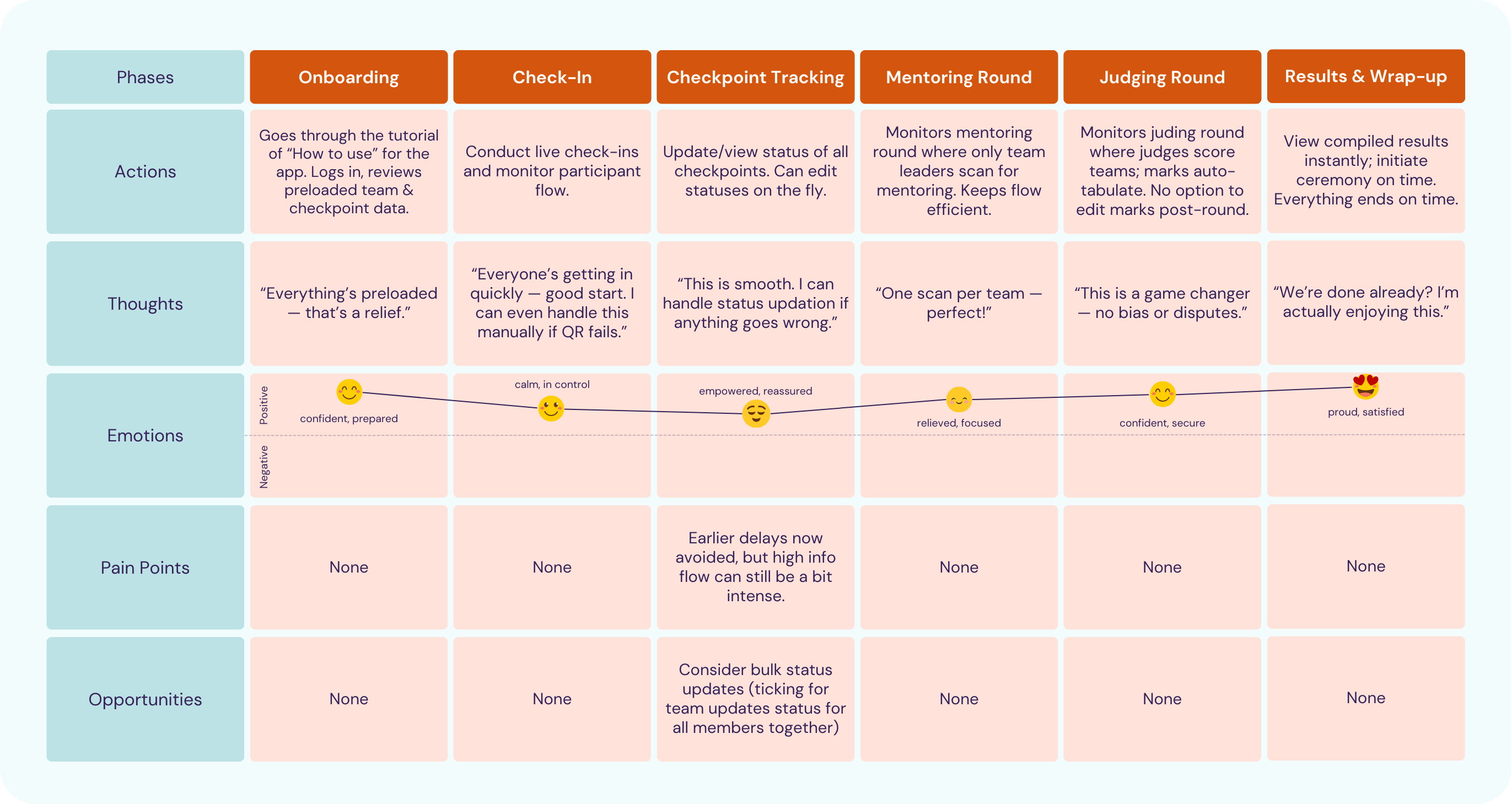
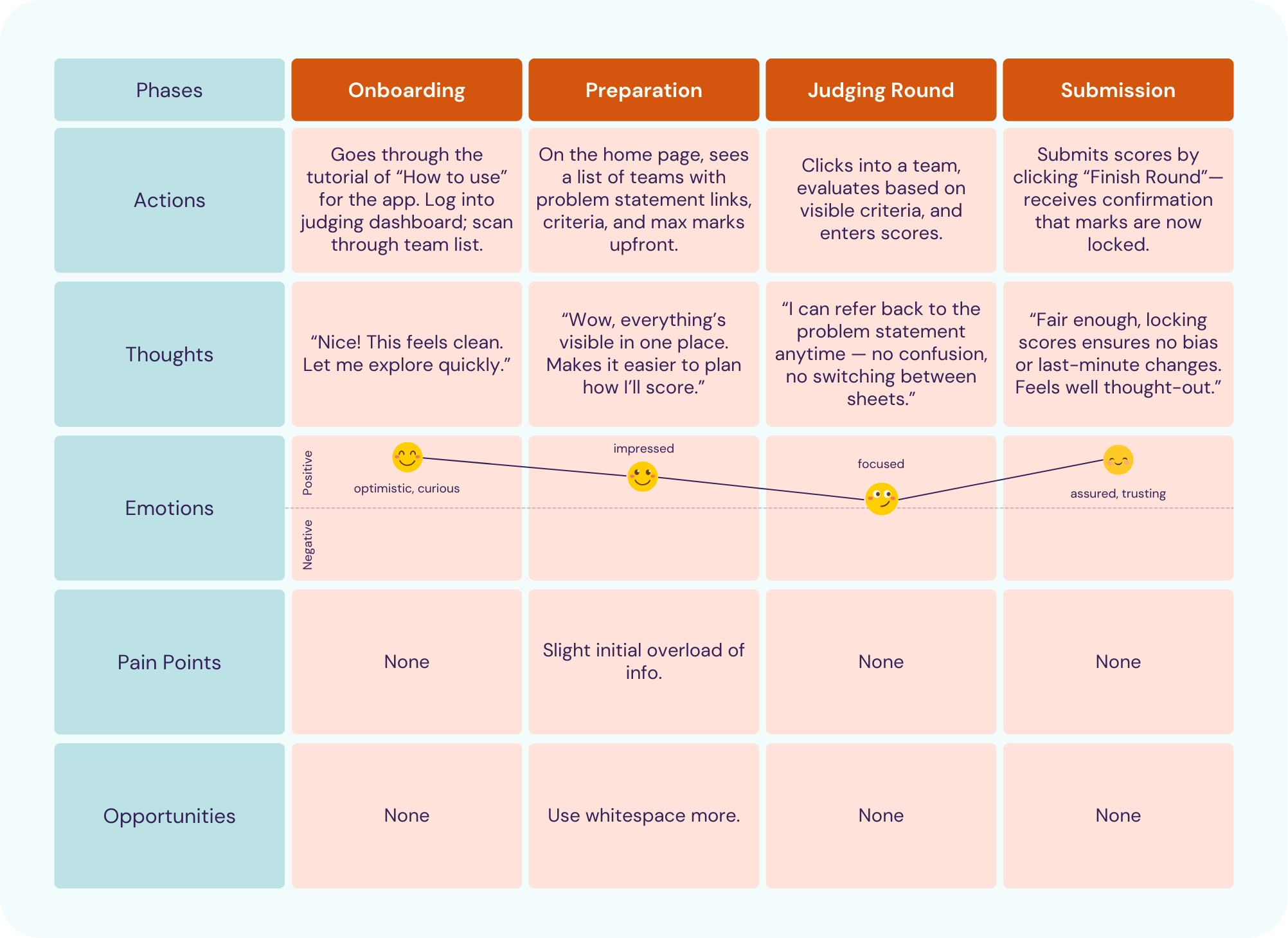
I recorded these observations as a user journey map.
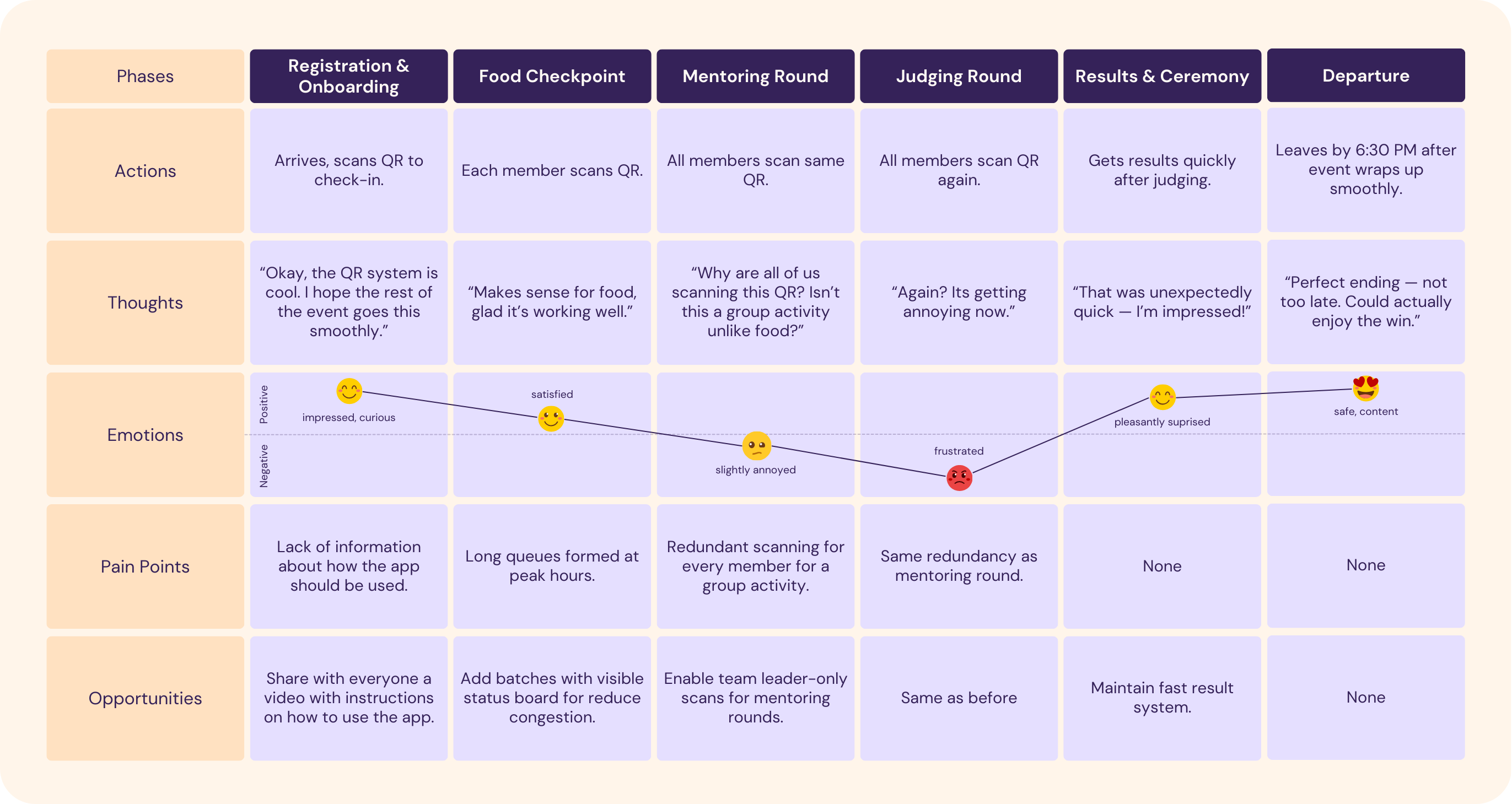
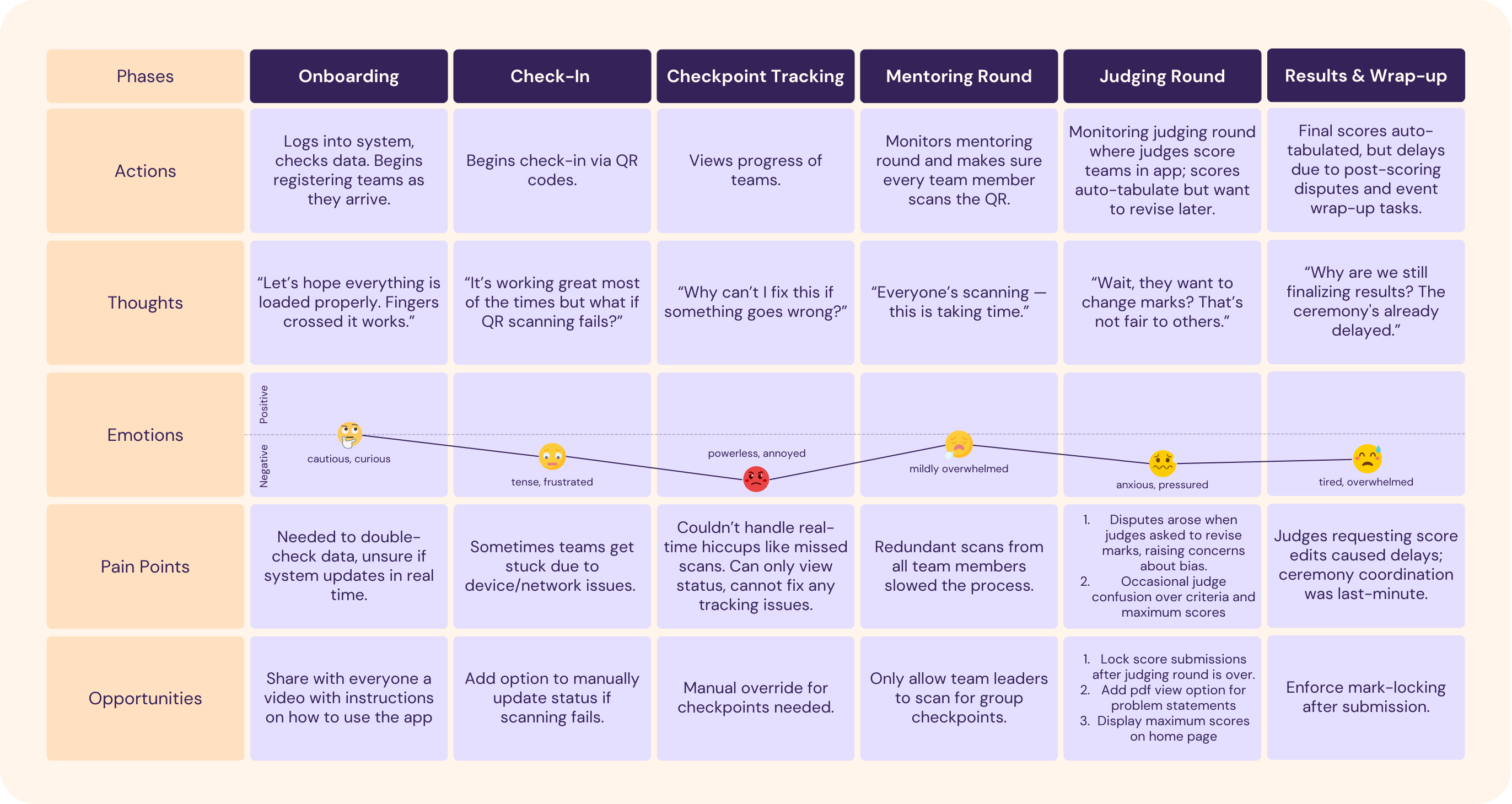
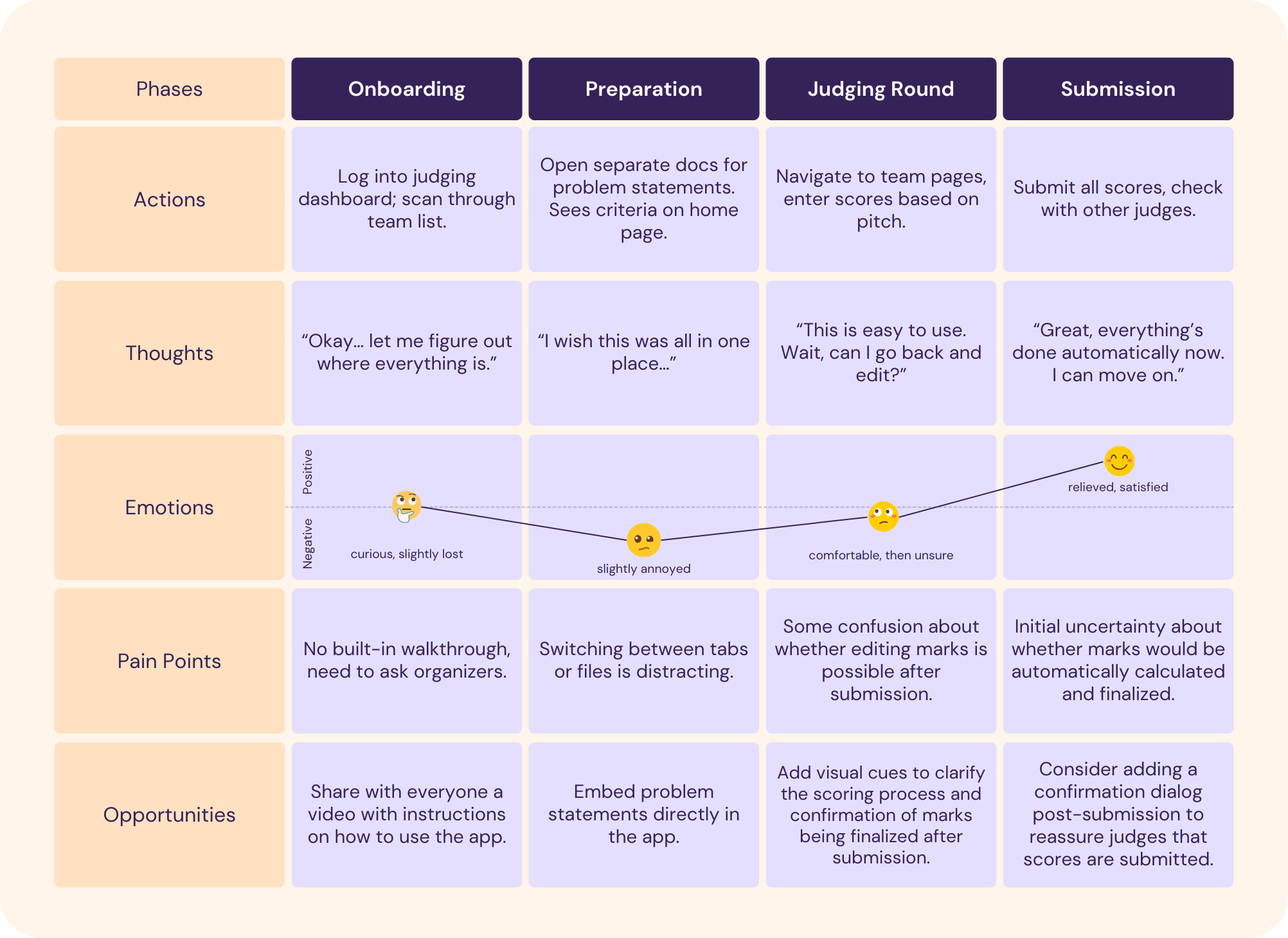
Improvements After Round 1 Testing
👥 Participant
- Showed mentoring and judging checkpoints only to the team leader, since these were team-level activities. This reduced redundancy and confusion.
🧑💼 Admin
- Added an option to manually update checkpoint status in case QR scanning fails.
- Introduced a bulk update button for each team to speed up status tracking under time pressure.
🧑⚖️ Judge
- Displayed the problem statement directly in the app so judges didn’t have to switch to Google Drive, letting them focus on evaluation.
- Showed max marks upfront, helping judges plan their score distribution more effectively.
- Added a "Finish Round" button with confirmation dialog box to lock scores and prevent post-submission bias, improving fairness.
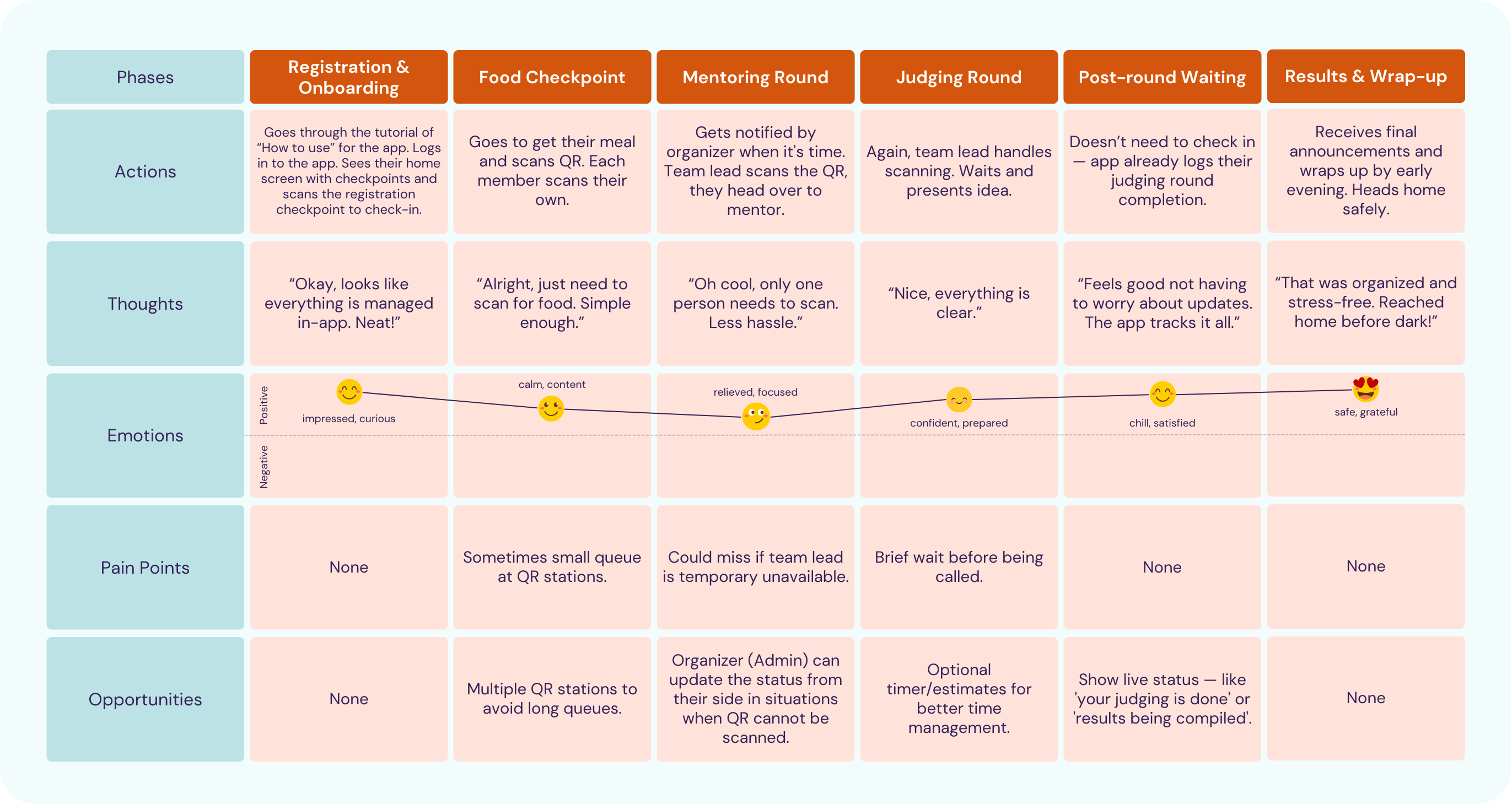
According to the opportunities found in Round 1 of Observation Testing, we incorporated the new features mentioned above and then conducted Round 2 of the testing with the different users to validate whether the improvements were effective or not.
Here are the observations as a user journey map.
Research → Ideation → Design → Testing & Iteration → Development
I led a team of 3 developers to build the platform using Flutter and Firebase. I handled the system architecture, delegated modules, ensured design-to-code alignment and actively contributed to the codebase. We focused on role-based access, real-time status updates, and automated score calculation with judge inputs locked after each round to prevent bias. The platform was tested and deployed in DJCSI’s app.
Impact
The solution was successfully deployed during CSI’s annual hackathon, delivering measurable improvements across participant experience, organizational efficiency, and overall event execution.
- Replaced manual paperwork with streamlined digital flows, saving over 6 hours and solving the problem of “24-hour hackathons” stretching into 40-hours.
- Encouraged safer and more inclusive participation by helping events wrap up on time, contributing to a 30% increase in female registrations.
- Gave judges a clear, all-in-one interface with team details, problem statements, and scoring rubrics, while locking scores post-submission to prevent bias and last-minute changes.
- Eliminated paper-based errors by digitizing tracking and tabulation, reducing confusion and significantly lightening the organizers’ workload.
- Improved coordination with participants by ensuring smoother check-ins, progress updates, and mentoring calls, fixing past issues of missed communication and delays.
Time to reflect!
Working on this project gave me a hands-on opportunity to design for real constraints — time pressure, shifting priorities, and multiple user roles interacting simultaneously.
Leading both design and development helped me bridge the gap between user needs and technical execution. I gained a deeper appreciation for the impact of micro-decisions like locking scores to prevent bias or limiting QR access for some checkpoints to team leaders to reduce redundancy.
Most importantly, it showed me the power of building tools that solve real problems, not just hypotheticals, and how good UX can directly contribute to safer, smoother, and more inclusive experiences.
This experience reminded me why I love product design: because when done right, it just works and it makes everyone’s life a little easier.